Surfshark vs NordVPN: which one is faster? Both VPNs offer OpenVPN, apps for all platforms, and access to their global network. When it comes to data, they have unique features. One wins.
Surfshark is the stronger choice for households with lots of devices and users who want more security and privacy tools bundled around their VPN. NordVPN makes a stronger case for users who prioritize its mature VPN feature set, specialty servers, and broader security ecosystem.
Neither is the right choice for everyone, so the useful question isn’t simply which VPN has more features. It’s which differences will actually matter after you subscribe.
Surfshark vs NordVPN: The Short Answer
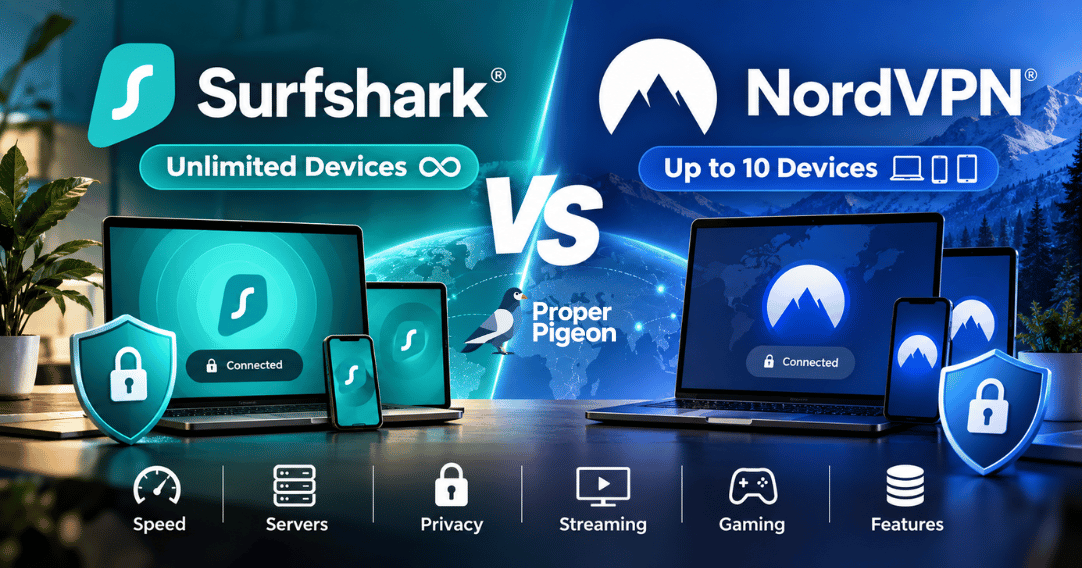
If you want to protect a large number of phones, laptops, tablets, TVs, and other devices without thinking about connection limits, Surfshark has the clearest advantage: it allows unlimited simultaneous connections. NordVPN currently supports up to 10 devices per account.
NordVPN, however, offers a particularly mature set of VPN-specific tools, including NordLynx, NordWhisper, Double VPN, Onion Over VPN, obfuscated servers, Meshnet, Threat Protection, and SmartPlay.
For many buyers, therefore, the decision comes down to this:
Choose Surfshark if: unlimited devices, household value, and the broader Surfshark One security bundle are important to you.
Choose NordVPN if: you place more value on its VPN-specific features, specialty connection options, and established privacy/security ecosystem.
| Category | Surfshark | NordVPN | Edge |
|---|---|---|---|
| Simultaneous devices | Unlimited | 10 | Surfshark |
| Money-back guarantee | 30 days | 30 days | Tie |
| Modern VPN protocol | WireGuard / additional protocols | NordLynx / additional protocols | Depends |
| Multi-hop | Dynamic MultiHop | Double VPN | Tie |
| Threat/ad blocking | CleanWeb | Threat Protection | Depends |
| Specialty VPN features | Strong | Very strong | NordVPN |
| Security bundle | Surfshark One available | Multiple Nord security tiers/tools | Depends |
| Best for many devices | Excellent | Good | Surfshark |
That table deliberately avoids declaring a winner for speed, streaming, or privacy based only on vendor claims. Those categories depend more heavily on location, testing methodology, platform, and current service behavior.
Pricing and Long-Term Value
Surfshark has historically competed aggressively on long-term pricing, while NordVPN also heavily discounts longer subscriptions. Because VPN promotions change frequently, comparing only the headline monthly figure can be misleading.
A better comparison is what you receive for the total subscription cost.
Surfshark’s unlimited-device policy creates real value if you have a large household or simply own many connected devices. One subscription can cover your computers, phones, tablets, and other supported devices without requiring you to manage a connection allowance. Surfshark currently advertises unlimited simultaneous devices and a 30-day money-back guarantee.
NordVPN currently allows 10 simultaneous devices and also provides a 30-day money-back guarantee. A VPN configured at the router level can cover additional devices while consuming one connection slot.
That makes the value question relatively straightforward: for a household with many devices, Surfshark’s unlimited connections are a meaningful advantage.
For a smaller number of devices, the connection limit matters much less. At that point, compare the actual checkout price and the features included in the specific plans you’re considering rather than choosing based on an advertised percentage discount.
Surfshark advantage: unlimited devices. NordVPN advantage: its 10-device allowance is already sufficient for many individual users.
Winner for large households: Surfshark.
Speed: Surfshark vs NordVPN
This is one area where the original comparison was too confident.
NordVPN uses NordLynx, its WireGuard-based protocol, while Surfshark supports WireGuard alongside its other connection protocols. Both are designed to deliver high performance without the overhead associated with older VPN configurations.
But that does not mean that one provider will always be faster for every user.
VPN performance depends on factors including your location, the VPN server you select, distance to that server, your ISP and its routing, congestion, protocol, and device and operating system.
There are independent tests that can help establish a broader performance pattern, but they should not be presented as if Proper Pigeon conducted those tests.
For practical buying purposes, both services are designed for high-bandwidth activities such as streaming and large downloads. If speed is critical for your connection, the most useful test is ultimately the route from your ISP and location to the servers you expect to use.
NordLynx vs OpenVPN
NordLynx is NordVPN’s implementation built around WireGuard technology, while Surfshark provides WireGuard support directly.
This distinction is worth knowing, but protocol branding alone shouldn’t decide which VPN you buy. What matters is the resulting combination of throughput, latency, reliability, and privacy on the devices and networks you use.
Verdict: too close and environment-dependent to name a universal speed winner without controlled current testing.
Server Network and Locations
The original draft repeatedly used old and conflicting server counts. That is particularly risky because VPN networks change constantly.
Surfshark currently advertises 4,500+ servers and coverage in more than 100 countries. NordVPN likewise operates a large global network, and its current materials advertise thousands of servers across a broad range of locations.
More servers can provide additional capacity and options, but raw server count should not be treated as a speed benchmark.
For most buyers, location coverage is more useful than the headline server number. Check whether the provider has suitable servers near you and in the regions you expect to use.
If both providers cover those locations, differences in routing and server performance may matter more than which network has the bigger number.
Privacy and Security
Both providers offer the fundamental protections you’d expect from a premium VPN: encrypted VPN connections, kill-switch functionality, modern protocols, DNS leak protection, and no-logs policies.
Surfshark also offers Dynamic MultiHop, which can route a connection through two VPN servers, and obfuscation capabilities intended to make VPN traffic less obvious.
NordVPN offers Double VPN for a similar multi-server approach, along with Onion Over VPN and obfuscated servers. Its current feature set also includes DNS leak protection and an automatic Kill Switch.
The important distinction is not that one VPN “has security” while the other doesn’t. Both have extensive security controls.
Instead, consider whether you actually need specialized tools such as multi-hop routing, obfuscation, a dedicated IP, malware protection, or additional identity/privacy services.
For an ordinary user who primarily wants to protect traffic on public Wi-Fi and reduce exposure of their IP address, many of the advanced features may never be used.
Surfshark One Changes the Comparison
This is where Surfshark becomes more interesting than a VPN-only comparison suggests.
Surfshark One combines the company’s VPN with additional cybersecurity/privacy capabilities. Surfshark currently offers products around antivirus protection, data-leak monitoring and other security/privacy functions alongside its VPN.
That matters if you were already planning to pay separately for some of those services.
But don’t assume that buying a bigger bundle automatically provides better value.
If all you need is a VPN, compare the VPN plans directly. If you also want endpoint malware protection and additional privacy monitoring, Surfshark One deserves a closer look because those extras become part of the purchasing decision.
Our view: evaluate Surfshark One as a security bundle, not simply as a more expensive VPN tier.
Check Out Surfshark on the Official Website →
Streaming Access
Both companies actively position their VPNs for streaming use. NordVPN includes SmartPlay, which is designed to help its VPN work smoothly with streaming platforms while maintaining an encrypted connection.
Streaming compatibility, however, is one of the fastest-changing areas of the VPN market. A service working with a particular streaming platform today doesn’t guarantee that every server, country, or platform will behave identically tomorrow.
For that reason, we wouldn’t choose between Surfshark and NordVPN based solely on a long list of streaming logos.
Instead, check support for the specific services and regions you care about and take advantage of the refund period if streaming access is one of your main reasons for buying a VPN.
Verdict: both are credible streaming choices; verify your specific services before committing long term.
Gaming
A VPN does not automatically reduce gaming ping.
Normally, sending traffic through a VPN adds another step between you and the game server. That can increase latency. A VPN can sometimes improve the route if your ISP is sending traffic through an inefficient path, but neither Surfshark nor NordVPN can fix bad Wi-Fi, local congestion, an overloaded game server, or the physical distance between you and the server.
So the question isn’t simply which VPN advertises the fastest protocol.
For gaming, prioritize: nearby VPN servers + low latency + stable routing + a modern protocol.
Both Surfshark and NordVPN provide modern high-speed protocols and extensive networks, so either can work well. Your own route will ultimately determine the result.
For a deeper explanation, see our NordVPN for Gaming: Can It Lower Ping or Will It Make Gaming Slower?
Verdict: don’t buy either VPN solely because you expect it to lower ping.
Apps, Devices, and Everyday Use
Both services provide apps across the major consumer platforms, including Windows, macOS, Linux, Android, iOS, and TV platforms.
The practical difference is again the connection allowance.
NordVPN’s 10-device limit should be enough for many individuals. A laptop, desktop, phone, tablet, television, and several additional devices can still fit within the account.
Surfshark removes that calculation entirely.
If you have a household full of connected devices — or share the subscription within your household — unlimited simultaneous connections are one of Surfshark’s most tangible advantages.
Winner: Surfshark.
Features That Actually Matter
Both companies now offer considerably more than an encrypted tunnel.
NordVPN’s feature set includes Threat Protection, Dark Web Monitor, Double VPN, Onion Over VPN, obfuscated servers, Meshnet, SmartPlay, and dedicated IP options.
Surfshark combines its VPN with features such as CleanWeb, Dynamic MultiHop and obfuscation, while its broader product portfolio includes Antivirus and additional privacy/security tools.
This is where feature lists can become misleading.
Ten features you never use aren’t necessarily better than three that solve actual problems.
For most users, we’d prioritize: reliable VPN connectivity, kill switch, modern protocol support, appropriate server locations, device coverage, and useful threat/privacy tools.
Features beyond those should be treated as differentiators only when they solve something you actually need.
Surfshark vs NordVPN: Which Should You Choose?
After stripping away the marketing and the feature-count competition, the choice is easier.
Choose Surfshark if you…
Want unlimited simultaneous connections, have a device-heavy household, value aggressive long-term value, or are interested in combining VPN functionality with the broader security/privacy tools available through Surfshark One.
Check Current Surfshark Pricing →
Choose NordVPN if you…
Want a mature VPN platform with a broad set of VPN-specific and security features such as NordLynx, Double VPN, Onion Over VPN, obfuscated servers, Meshnet and Threat Protection, and its 10-device allowance is sufficient for you.
Check Current NordVPN Pricing →
Our Verdict
For a typical household choosing between these two, we’d lean toward Surfshark when value and device flexibility are the priority. Unlimited simultaneous connections are a concrete advantage rather than a feature most people will never use.
Surfshark One becomes especially interesting if you also want some of the additional security tools included in the broader Surfshark ecosystem.
NordVPN remains the stronger alternative for someone specifically attracted to its VPN-focused feature set and specialty connection options. Ten simultaneous devices are also enough that Surfshark’s unlimited allowance won’t matter to every buyer.
Neither choice requires pretending that one service wins every category.
Our default recommendation for a multi-device household: Surfshark.
Our alternative for users prioritizing NordVPN’s specialty VPN features: NordVPN.
Frequently Asked Questions
Is Surfshark better than NordVPN?
Surfshark is the better fit for users who value unlimited simultaneous connections and the broader Surfshark security ecosystem. NordVPN may be the better fit if its specialty VPN and security features are more important to you. There isn’t a credible reason to declare either service universally better for every user.
How many devices can I use with Surfshark and NordVPN?
Surfshark currently allows unlimited simultaneous connections, while NordVPN allows up to 10 devices per account.
Is NordVPN faster than Surfshark?
We wouldn’t make that universal claim without controlled current testing. VPN performance varies by server, location, ISP, protocol, congestion, and device. Both offer modern protocols designed for high-performance connections.
Which is better for families?
Surfshark has a meaningful advantage for households with many devices because it doesn’t impose a simultaneous-device limit. NordVPN’s 10-device allowance, however, will still be enough for many households.
Do Surfshark and NordVPN offer money-back guarantees?
Both currently advertise 30-day money-back guarantees.